
Mass Driver Concept
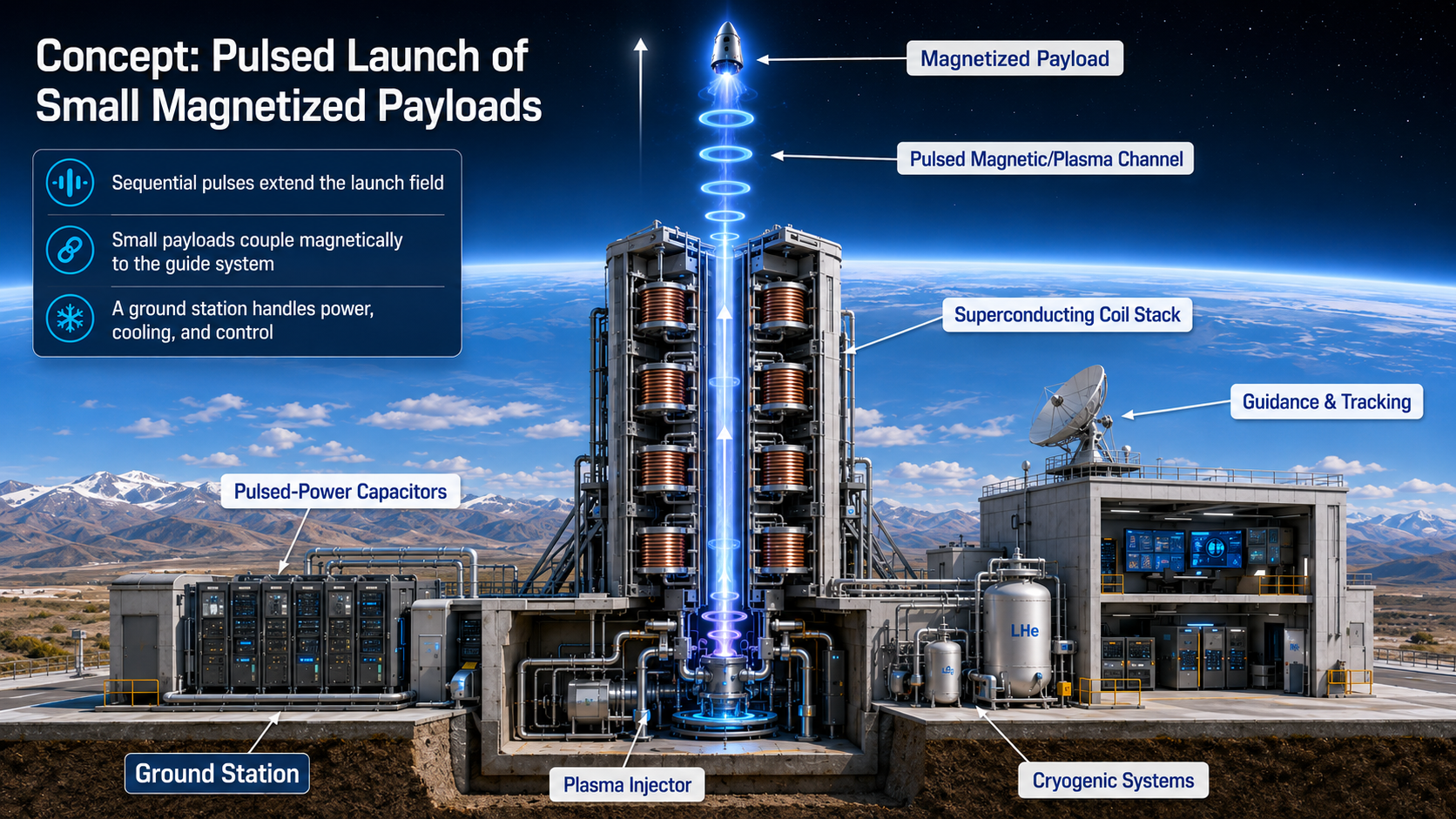
Concept: Pulsed Launch of Small Magnetized Payloads
A Ground-Station Concept for Extending Magnetic Control Beyond Fixed Hardware
Use the ground-station illustration as the opening visual.
Slide 1 — The Big Idea
Could a ground station launch small magnetized payloads using timed magnetic pulses and short-lived magnetized plasma structures?
This concept explores a launch system in which a powerful ground station creates a controlled vertical magnetic channel, accelerates a compact magnetized payload, and uses pulsed plasma-assisted magnetic structures to extend magnetic control beyond the fixed launch hardware.
It is not a space elevator, a conventional rocket, or a giant magnet reaching into space.
It is closer to a pulsed electromagnetic launch system combined with magnetized-plasma research.
Slide 2 — Why Small Payloads First?
The first payloads should be small, rugged, and unmanned:
Sensor packages
Atmospheric instruments
Communications relays
Calibration targets
Small scientific probes
Magnetized test vehicles
Material samples
Propellant or plasma-diagnostics packages
A system like this would not begin by launching people or large spacecraft.
Small payloads can tolerate much higher acceleration, can carry simpler magnetic hardware, and allow rapid experimental testing.
Start with a controllable test article, not a passenger vehicle.
Slide 3 — The Ground Station Is the Real Machine
The visible launch tube is only one part of the system.
The ground station would contain:
Superconducting coil stacks to create strong, shaped magnetic fields
Pulsed-power capacitor banks to release very large electrical pulses quickly
Cryogenic systems to keep superconducting magnets cold
A plasma injector to create controlled magnetized plasma pulses
Guidance and tracking systems to measure payload position and velocity
Fast control electronics to synchronize every magnetic pulse
The payload may be small, but the supporting infrastructure would be large, heavy, and power-hungry.
Slide 4 — The Basic Launch Sequence
1. A small payload enters the launch tube.

2. Superconducting coils establish a strong, controlled guide field.

3. Pulsed coils create a moving magnetic acceleration pattern.

4. The payload is accelerated upward through the tube.

5. A plasma injector launches a magnetized plasma pulse behind or around the payload path.

6. The plasma pulse temporarily carries a structured magnetic field beyond the fixed coil hardware.

7. The payload exits the station and coasts, or is handed off to another capture system.
The main idea is not that plasma replaces the launch coils.
The plasma is a possible temporary extension and shaping element beyond the fixed magnetic structure.
Slide 5 — What Is Already Established Physics?
Several parts of this concept are based on real research and existing engineering principles.
Electromagnetic launch:
Sequentially timed coils can accelerate a conducting, magnetized, or coil-equipped payload. The timing of each stage matters because the magnetic field must pull or push at the correct moment.
Superconducting magnets:
Large superconducting coil systems already create and shape intense magnetic fields for fusion research and other scientific equipment. Fusion systems use powerful magnetic fields to confine and control plasma.
Magnetized plasma jets:
Laboratory experiments have created high-speed, strongly magnetized plasma jets and studied how their magnetic fields form, collimate, and become unstable.
Slide 6 — The Plasma-Extension Idea
A plasma is not automatically a magnet.
For plasma to generate a useful magnetic field, it must contain organized electrical currents.
moving charged particles
        ↓
electric current
        ↓
self-generated magnetic field
        ↓
magnetized plasma structure
A carefully formed plasma pulse could contain:
A central current channel
An outer return-current path
A wrapping magnetic field
A seeded axial magnetic field from the ground station
A helical or flux-rope-like magnetic structure
In idealized plasma physics, magnetic flux can move with a highly conductive plasma. This is often described as a “frozen-in” magnetic field.
Slide 7 — Think of It as Pulses, Not One Endless Tube
The concept does not require one permanent magnetic tube extending from Earth to orbit.
Instead, it uses a train of short-lived magnetic-plasma structures.
Fixed magnetic launch tube
          ↓
Pulse 1: magnetized plasma packet
          ↓
Pulse 2: magnetized plasma packet
          ↓
Pulse 3: magnetized plasma packet
          ↓
Temporary moving magnetic corridor
Each pulse would have to be created, measured, corrected, and stabilized independently.
This is much more realistic than expecting one unsupported magnetic field to remain narrow over hundreds of miles.
Slide 8 — What the Payload Would Need
The payload would need to interact strongly and predictably with the station’s magnetic fields.
Possible payload approaches include:
A compact superconducting loop
A permanent magnet plus active steering coils
Conductive rings that develop induced currents
An onboard electromagnetic coil system
A magnetically shielded instrument capsule
Optical and radio navigation markers
The payload would also need:
Heat protection
High-acceleration structural support
Precise orientation control
A safe failure mode
Communication with the ground station
A recovery or orbital-capture plan
The vehicle should be designed as a magnetic test article, not as a conventional rocket.
Slide 9 — What the Plasma Adds
A pulsed magnetized plasma structure could potentially provide several benefits:
Extend magnetic influence beyond the solid launch tube
Help shape and collimate charged particles
Carry a temporary self-generated magnetic field
Test new methods of plasma-field coupling
Create a moving magnetic environment around a small payload
Support advanced plasma-propulsion or particle-beam experiments
But plasma does not create a rigid invisible railroad track.
It expands, loses density, develops instabilities, and can reconnect or rearrange its magnetic field. Laboratory magnetic-tower and plasma-jet experiments have observed current-driven instabilities that can disrupt or reshape the jet structure.
Slide 10 — The Hard Problems
This is where the concept becomes advanced research rather than near-term transportation.
Major challenges
Plasma stability
The plasma pulse must remain narrow and organized long enough to be useful.
Payload coupling
A small vehicle must stay centered and interact with the moving field predictably.
Power delivery
Pulsed magnets and plasma injectors require extremely high peak power.
Heating and losses
High currents, plasma radiation, eddy currents, and electrical resistance all create heat.
Atmosphere
Launching through dense air creates drag, shock heating, ionization, and turbulence.
Safety
A failed pulse, a quenching superconducting magnet, or an off-axis payload could be dangerous.
Guidance
The entire system must react in milliseconds or faster to keep the payload centered.
Slide 11 — A More Realistic Development Path
The best way to develop this idea is in steps.
Phase 1 — Laboratory-scale pulsed magnetic launcher
Launch small conductive or magnetized test rings through a short coil stack.
Phase 2 — Vacuum-tube magnetic acceleration
Test active payload guidance, pulse timing, and magnetic braking without atmospheric drag.
Phase 3 — Magnetized plasma-pulse experiments
Launch controlled plasma packets and measure field strength, shape, expansion, and instability growth.
Phase 4 — Payload-plasma coupling
Determine whether a small magnetic payload can remain centered inside or near a controlled magnetized plasma pulse.
Phase 5 — High-altitude test facility
Use a vertical vacuum tube, mountain site, or balloon-supported experiment to reduce atmospheric effects.
Phase 6 — Orbital handoff concept
Use the ground system only for the first acceleration stage, then transfer the payload to a rocket, tether, orbital catcher, or other propulsion system.
Slide 12 — The Ground Station as an Experimental Platform
Even if it never becomes a launch system, the ground station could be valuable as a research platform.
It could investigate:
Pulsed superconducting magnet systems
High-current switching
Plasma injection and confinement
Magnetic nozzle behavior
Magnetized payload stabilization
Plasma diagnostics
Electromagnetic launch methods
Rapid-response guidance systems
Energy recovery during magnetic braking
The first major success would not be “launching to orbit.”
The first success would be repeatedly launching a small magnetized test payload through a controlled pulsed magnetic-plasma environment and collecting reliable data.
Slide 13 — The Honest Conclusion
This concept is not proven transportation technology.
A ground-based plasma-assisted magnetic launcher would face enormous challenges in power, stability, atmospheric passage, control, and safety.
But the building blocks are real:
Timed electromagnetic acceleration
High-field superconducting magnets
Pulsed-power systems
Magnetized plasma jets
Plasma self-fields
Magnetic guidance and braking
High-speed control systems
The speculative leap is combining them into a system where pulsed plasma structures temporarily extend the magnetic environment beyond fixed hardware and help guide small magnetized payloads.
The practical question is not “Can magnets reach all the way to orbit?”
The better question is: “Can a ground station create a sequence of controlled magnetic environments that hand a small payload from one stage to the next?”
That is a much more interesting research problem.
Closing Caption
Pulsed Launch of Small Magnetized Payloads is a speculative concept for combining superconducting magnetic launch hardware with short-lived magnetized plasma structures. The goal is not to build a permanent magnetic elevator to space, but to investigate whether a sequence of carefully controlled magnetic pulses could extend guidance and acceleration beyond a fixed ground-based coil system.
The concept remains far beyond existing launch technology, but it connects real research areas: electromagnetic launch, high-field superconducting magnets, pulsed power, plasma jets, and magnetic confinement.